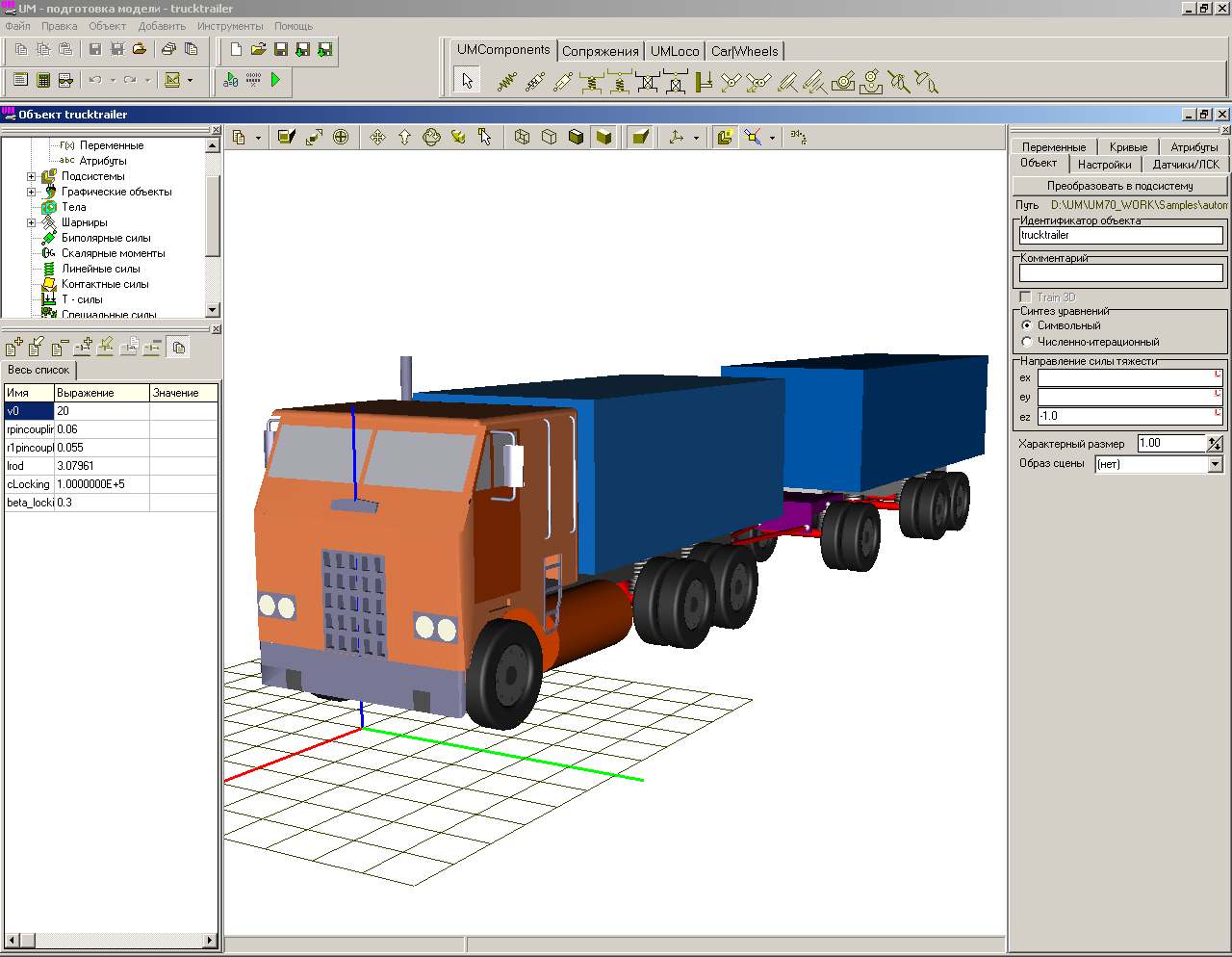
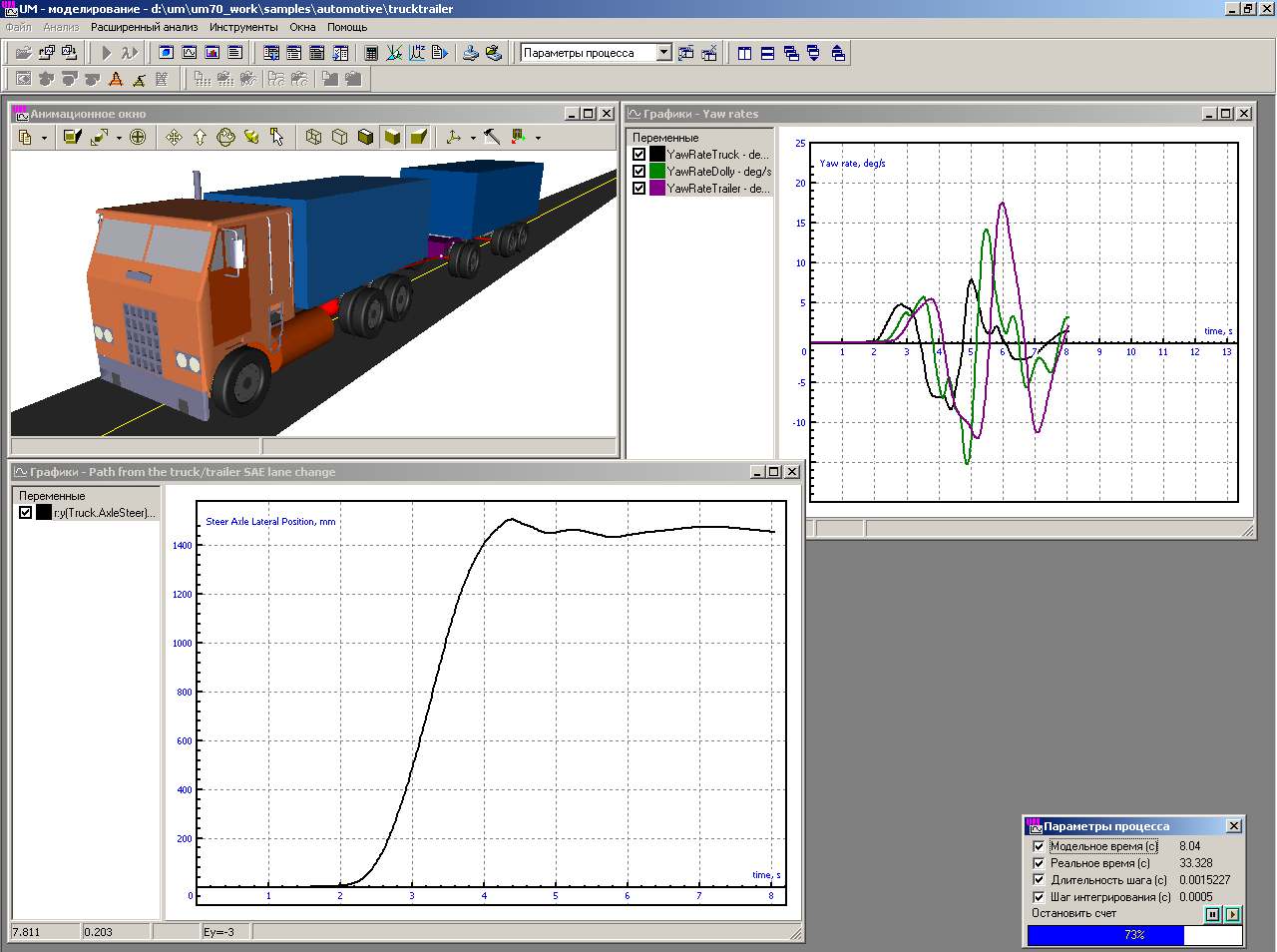
The UM Automotive ModuleUM Automotive includes mathematical models of tires, program tools for description of road plan and road excitations. UM Automotive includes as well set of typical maneuvers, suspensions, steering systems and elements of trasmission. Module gives user the possibility to estimate dynamical behavior of the vehicle, including forces in the suspension force elements, safety and "road holding" factors, etc...
Read more
The UM Train ModuleUM Train module automates the process of train model creation and the analysis of obtained results. The module allows computing the longitudinal dynamics of train in braking, traction and idling modes on a railway track of any configuration...
Read more
The UM Loco Module: Simulation of Railway Vehicle DynamicsThe program package includes module UM Loco intended for simulation of railway vehicle dynamics in both straight and curve railroad tracks. The simulation is performed in time domain by means of numeric integration of differential or differential-algebraic equations of motion. UM Loco allows the user to create fully parameterized models of vehicles...
Read more
The UM Tracked VehicleThe UM Tracked Vehicle module of UM software has been developed for an automatic generation of models of tracked vehicles and analysis of their dynamics...
Read more
The UM FEM ModuleThis module let the user a possibility to introduce into a mechanical system deformable bodies undergo large reference displacement but small deformation. Such an approach makes more exact results in comparison with multibody simulation and could be very useful in some cases. This approach could be useful for research of vibration of car body and carriage underframe during the motion of railway vehicle subject to influence from railway track irregularities and a power generating set...
Read more
The CAD Interfaces ModuleModern approach to design of machines and mechanisms assumes creating 3D models with the help of one of the computer-aided design (CAD) software with parallel strength and dynamics analysis. To simplify importing such models from CAD software to Universal Mechanism we developed tools for direct data import from CAD software to Universal Mechanism. Such import tools are collected within the UM CAD Interfaces module. The current UM version supports data import from Autodesk Inventor, SolidWorks, Unigraphics NX, KOMPAS and Pro/ENGINEER...
Read more
The UM Experiments ModuleIt is often required in engineering practice to carry out series of numerical experiments, for example to analyze dynamical behavior and sensitivity of mechanical system or to find out optimal parameters of the system. The built-in module UM Experiments includes a set of tools (scanning, optimization, approximation), for advanced analysis of dynamics of mechanical systems...
Read more
The UM ControlUniversal Mechanism includes UM Control module, which provides interface between Universal Mechanism and Matlab/Simulink. The user can compile his/her own Matlab/Simulink model and attach it into the Universal Mechanism. Matlab/Simulink interface gives the user a possibility to include unlimited number of Matlab/Simulink libraries and interactively turn on/off interfaces...
Read more
The Module of Linear Analysishe module of linear analysis is a built-in part of the basic UM version.
ОThe module provides the following facilities:
— searching equilibrium positions of a system;
— linearization of equations of motion in the equilibrium position;
— calculation of natural frequencies and animation of natural modes of the system;
— plotting the root locus;
— calculation of the critical velocity of railway vehicles (available for railway version)...
The Subsystem Module Subsystem technique is a basis of modeling objects with large number of degrees of freedom and creation of database of typical design elements for modeling technical systems. By using this method an object is represented as a tree of subsystems, which are linked by means of force elements and constraints. Any object previously created by the user can be a subsystem. This object may contain any tree of subsystems...
Read more
The Fatigue Analysis ModuleThe fatigue analysis starts with the dynamical hybrid model in Universal Mechanism. The flexibility characteristics of the structural parts are incorporated into UM model using a modal formulation based upon component mode synthesis. Basically, this method represents the part's flexibility using a modal basis, which is optimized to account for constraint and force locations. The mode shape displacements and stresses are calculated using the finite element software. The UM Durability module combines the stress time history information generated during series of numerical experiments in UM and the material fatigue strength characteristics to generate the predicted life distribution in the part...
Read more
The Granular Media ModuleThis module allows including in a UM model a planar granular media, which is a set of particles (rigid polygons and circles). The particles interact with each other by contact forces. Simple models of contact forces are used in the module. Each force consists of two components. The first component is a linear viscoelastic normal force. Another one is a dry friction force with two modes: sliding and sticking...
Read more
The 3D Contact ModuleThis module allows simulating of contact interaction of bodies by contact manifolds (graphical objects). The realized contact algorithm is based on the simulation of interaction of arbitrary convex polyhedrons. The set of supplied primitives includes the following types: box, cylinder, cone, ellipsoid, and polyhedron...
Read moreProgram package "Universal Mechanism" is intended for simulation of kinematics and dynamics of planar and spatial mechanical systems.
The program is oriented to practical engineers, students and teachers, in other words it is oriented to all people who are involved in problems of dynamics of machines and mechanisms. Mechanical systems are described by means of representing them as systems of rigid bodies connected by various kinematical pairs and force elements, so-called multibody systems.
Online animation of motion and plots of dynamical performances are available during simulation. There are lots of measurable dynamical performances of mechanical systems: linear and angular coordinates, velocities and accelerations, active forces and moments, reaction forces, etc.
UM has an advanced postprocessor, which includes: linear analysis, statistics, multivariant calculation and optimization and export of results. UM is a useful tool for the computer-aided modeling of multibody and hybrid systems of various types: complex aerospace structures, robots, railway vehicles, automobiles, cable systems, etc. It gives an opportunity to solve both the direct and inverse kinematic, dynamic, and control problems. There are special prices of UM for scientific and educational purposes.

UM includes kernel and number of additional task-oriented modules: (UM Automotive), (UM Loco), (UM Tracked Vehicle), (UM CAD Interfaces), (UM FEM), UM Experiments, UM Control and others.
Our engineers can help you to carry out dynamic research of your mechanical systems.
Download UM 6.0 and get three-month free license here.
Using UM for modeling of mechanical systems, main features of the program package, its modules and lots of animations are presented here (PowerPoint presentation, zip-archive, 83 Mb).
- Body of any shape
- Automatic calculation of inertia parameters
- Import inertia properties of bodies from Unigraphics NX, Pro/ENGINEER, SolidWorks, Autodesk Inventor, KOMPAS-3D.
- Rotational, translation, cylindrical, gimbal, general, quaternion joints
- Massless rod
- Import of the kinematic schemes from CAD programs.
- General, bipolar, contact, special and other forces
- Polyhedron, ellipse, box, spiral, ellipsoid, cone, parametrical, profile
- Import from ASC and 3DS files
- Import from Unigraphics NX, Pro/ENGINEER, SolidWorks, Autodesk Inventor, KOMPAS-3D.
- Linear and angular coordinates, velocities and accelerations
- Active forces and moments
- Reaction forces
- Other user,s parameters
- Run, pause, reset, stop the simulation any time
- Control the accuracy of the simulation
Supporting user,s modules under:
- MS Visual C++;
- Borland C++ Builder;
- Borland/Turbo Delphi;
- any program language/IDE that can output Dynamic-Linked Library (DLL) to be loaded as external libraries.
- Object animation
- Trajectories
- Velocities, accelerations, forces, moments as vectors
- All measurable parameters as plots
- 3DS files
- ASC files
- SolidWorks, Autodesk Inventor and other CAD programs (graphics, inertia properties and kinematics)
- Matlab/Simulink models
- BMP files
- Animated GIF files
- AVI files
- Measurable parameters to formatted text files
- Tables and graphs to MS Word and MS Excel
- Microsoft Windows 2000/XP/Vista
- Pentium PC, 3 GHz
- 2 Gb RAM memory
- 300 Gb HDD
- up-to-date/professional video card is strongly recommended in the case of working with bodies imported from CAD or FEM software
New UM 6.0 release is available now.
Read moreNew UM Tracked Vehicle module, intended for simulation of tracked vehicle dynamics, is released. Detailed informaton about the module is here. Module will be available in UM software since UM 6.0

Programme and Abstracts. EUROMECH 398, Colloquium on Fluid-Structure Interaction in Ocean Engineering, Technical University Hamburg-Harburg, Hamburg, Germany, October 11-14, 1999.
Read moreNumerical algorithms, pp. 183-194, 1998.
Read moreSeismological Research Letters, Volume 81, Number 5, September/October 2010, P. 804-810.
Read moreСборник трудов ДИИТа №14, Днепропетровск, ДИИТ, 2007. С. 123-127.
Read more