 English
 Русский

Home Page
Program package "Universal Mechanism" is intended for simulation of kinematics and dynamics of planar and spatial mechanical systems.
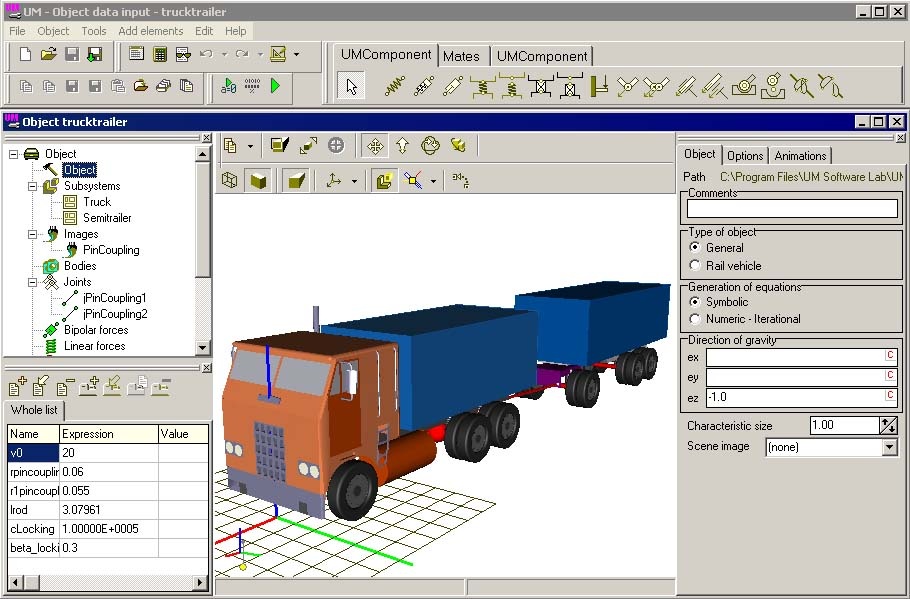 The program is oriented to practical engineers, students and teachers, in
other words it is oriented to all people who are involved in problems of dynamics
of machines and mechanisms. Mechanical systems are described by means of representing
them as systems of rigid bodies connected by various kinematical pairs and
force elements, so-called multibody systems.
The program is oriented to practical engineers, students and teachers, in
other words it is oriented to all people who are involved in problems of dynamics
of machines and mechanisms. Mechanical systems are described by means of representing
them as systems of rigid bodies connected by various kinematical pairs and
force elements, so-called multibody systems.
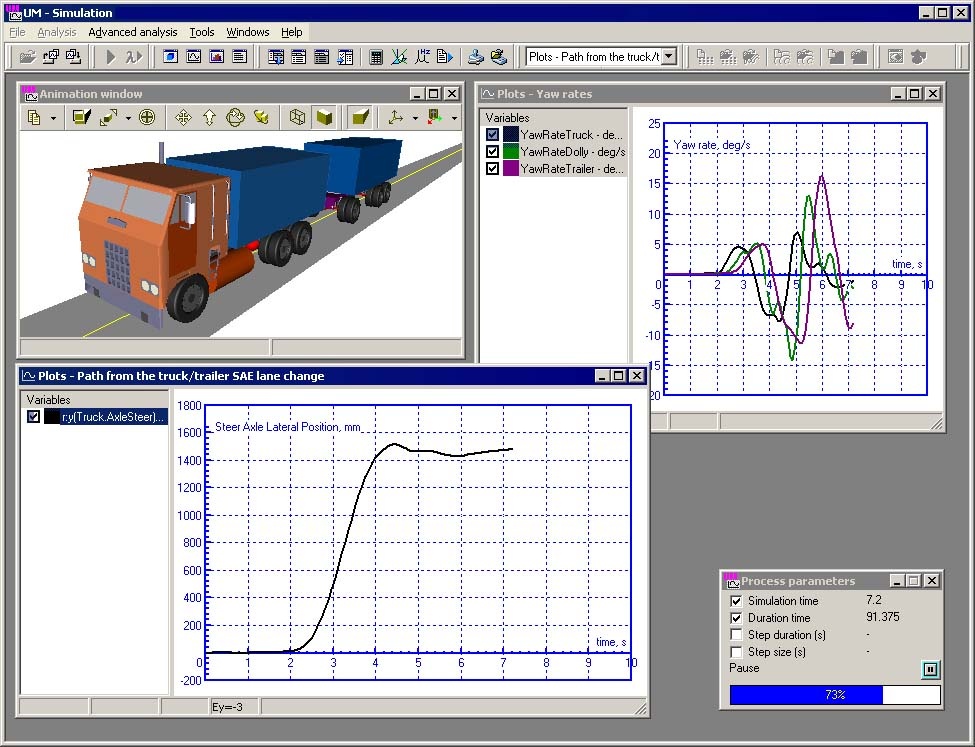 Online animation of motion and plots of dynamical performances are available
during simulation. There are lots of measurable dynamical performances of
mechanical systems: linear and angular coordinates, velocities and accelerations,
active forces and moments, reaction forces, etc.
Online animation of motion and plots of dynamical performances are available
during simulation. There are lots of measurable dynamical performances of
mechanical systems: linear and angular coordinates, velocities and accelerations,
active forces and moments, reaction forces, etc.
UM has an advanced postprocessor, which includes: linear analysis, statistics, multivariant calculation, wear and durability analysis and
export of results. UM is a useful tool for the computer-aided modeling of
multibody and hybrid systems of various types: complex aerospace structures,
robots, railway vehicles, automobiles, cable systems, etc. It gives an opportunity
to solve both the direct and inverse kinematic, dynamic, and control problems.
There are special prices of UM for scientific and educational purposes.
UM includes kernel and number of additional task-oriented modules: UM Automotive, UM Loco, UM Tracked Vehicle, UM CAD Interfaces, UM FEM, UM Experiments, UM Control and others.
Our engineers can help you
to carry out dynamic research of your mechanical systems.
Download the latest UM release and know more details about free trial
license here.
Using UM for modeling of mechanical systems, main features of
the program package, its modules and lots of animations are presented here (PowerPoint presentation, zip-archive, 83 Mb).
 Body
properties
Body
properties
- Body of any shape
- Automatic calculation of inertia
parameters
- Import inertia properties of bodies from Unigraphics
NX, SolidWorks, Autodesk Inventor, KOMPAS-3D, Pro/E, PTC Creo.
Joints
and constraints
- Rotational, translation, cylindrical, gimbal, general,
quaternion joints
- Massless rod
- Import of the kinematic
schemes from CAD programs.
Forces
- General, bipolar, contact, special and other forces
Graphical
elements
- Polyhedron, ellipse, box, spiral, ellipsoid, cone, parametrical,
profile
- Import from ASC and 3DS files
- Import from
Unigraphics NX, SolidWorks, Autodesk Inventor, KOMPAS-3D.
Measurable
parameters
- Linear and angular coordinates, velocities and accelerations
- Active forces and moments
- Reaction forces
- Other user,s parameters
Simulation
control
- Run, pause, reset, stop the simulation any time
- Control
the accuracy of the simulation
User,s modules definition
Supporting user,s modules under:
- MS Visual C++;
- Borland C++ Builder;
- Borland/Turbo Delphi;
- any program
language/IDE that can output Dynamic-Linked Library (DLL) to be loaded
as external libraries.
Visualization
- Object animation
- Trajectories
- Velocities,
accelerations, forces, moments as vectors
- All measurable
parameters as plots
Import
- 3DS, ASC, STL files
- STEP/IGES files
- KOMPAS 3D,
Autodesk Inventor, Unigraphics NX, SolidWorks, Creo,
Pro/ENGINEER (graphics and inertia properties)
-
Matlab/Simulink models
Export
- BMP files
- Animated GIF files
- AVI files
-
Measurable parameters to formatted text files
- Tables and graphs
to MS Word and MS Excel
Recommended
system requirements
- Microsoft Windows 7/8/10/11
- CPU 3 GHz (multi-core CPU are
recommended)
- 8 Gb RAM
- 4 Gb free space on HDD
-
up-to-date/professional video card is strongly recommended in the case
of working with bodies imported from CAD or FEM software; NVIDIA
graphics cards are highly recommended.